Chewton Mendip Church of England Primary School
Spring Term 1
A Busy and Brilliant Half Term of Learning
Despite a very rainy January and February, we have enjoyed an excellent half-term packed full of exciting learning across the curriculum.
In English, we began by exploring myths and traditional tales. The children designed their own heroes and monsters before writing Greek-inspired myths using a clear five-paragraph structure. A strong focus was placed on character description, ambitious vocabulary and narrative structure, linking directly to the Upper Key Stage 2 English National Curriculum expectations for pupils to plan and write narratives that develop characters and settings, use a range of cohesive devices, and select vocabulary and grammatical features appropriate to purpose and audience.
We then moved on to non-chronological reports about the Ancient Greeks. Pupils developed their use of subject-specific language, fronted adverbials and adverbials of cause, while practising editing and redrafting to improve clarity, accuracy and impact. This reflects the Year 5 and 6 requirement to assess the effectiveness of their own and others’ writing and to propose changes to vocabulary, grammar and punctuation to enhance meaning.


Our English learning linked beautifully with History, where we explored the question: What is the legacy of the Ancient Greek civilisation? Pupils learned where the Ancient Greeks lived, explored their beliefs through gods and goddesses, compared Athens and Sparta using a range of secondary sources, and deepened their understanding of Athenian democracy by taking part in a debate. They also used research skills to explore the significance of Ancient Greek philosophers and evaluated the lasting legacy of Greek civilisation on the modern world.
In Science, our topic was Space. Pupils described the movement and relative positions of the Earth, Moon and Sun, developed models of the Solar System, and explained the causes of day and night and the seasons. They also practised recording information clearly, including designing and using tables, as set out in the Upper KS2 science curriculum.


In Mathematics, our learning focused on decimals, fractions and percentages, with clear links to the Year 5 and 6 National Curriculum. Pupils practised reading, writing, ordering and comparing decimal numbers, including those with up to three decimal places. They explored equivalences between fractions, decimals and percentages, and applied this knowledge to problem-solving and reasoning activities. Children were encouraged to use formal written methods accurately and to explain their mathematical thinking, meeting the curriculum expectation to develop fluency, reasoning and problem-solving skills.


In PE, we focused on fitness through circuit training, targeting different muscle groups and developing stamina and strength. RE introduced Judaism, including learning about Abraham, Shabbat and Bar and Bat Mitzvah. In Computing, pupils programmed micro:bits, developing their understanding of algorithms and debugging. Music involved composing protest songs, while in DT pupils designed and made pop-up books. In PSHE, we began our learning about safety, including online safety and choking awareness.


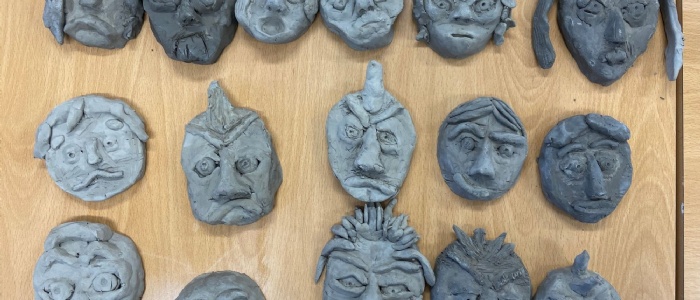
We also enjoyed a fabulous Arts Week inspired by Norman Rockwell and the theme of emotions. Pupils created expressive clay faces, vibrant self-portraits using styrofoam printing, and digital recreations of The Gossip. A highlight of the half-term was our visit to the museum, which brought our learning to life.


To finish the half-term, the class became completely fascinated with Winter Olympic curling — a fun and unexpected interest that rounded off a fantastic few weeks of learning.