
Chewton Mendip Church of England Primary School
A New Start!
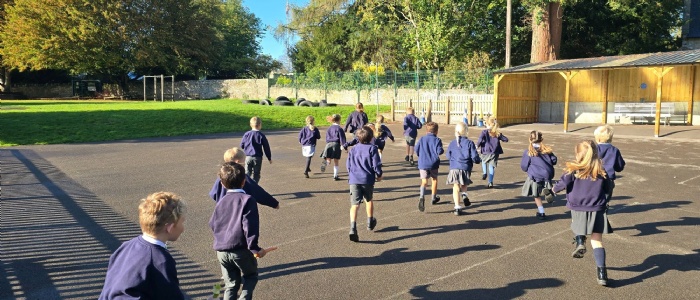
We have enjoyed welcoming the new children to Owl Class and they have settled in brilliantly. They have quickly learnt where things are in the classroom and all the new routines. The children have been very supportive of each other and have been delighting us with their lovely personalities! We have been blown away by their curiosity and enthusiasm for learning.
In English our first focus book was 'The Big Book of the UK' which contains facts, folklore and fascinations from around our islands. We particularly enjoyed learning about our interesting landmarks, fabulous foods and native wildlife. We learnt to write lists of their favourite foods which we turned into delicious menus, captions and labels to go with pictures of UK animals extending to writing descriptive sentences about them. We then moved on to the classic book 'The Tiger Who Came to Tea' by Judith Kerr. We worked on sequencing and writing sentences, captions to go with illustrations from the book and planned and wrote our own versions of the story, with our own animals and human characters.


In maths we started the term with a Place Value unit. This term, our mixed Year 1 and 2 class has been developing their understanding of place value through a range of practical and engaging activities. The children have been using manipulatives, such as base ten equipment and counters, to represent numbers and deepen their understanding of tens and ones. Year 1 pupils have focused on counting, ordering and comparing numbers, while Year 2 pupils have extended their learning by exploring larger numbers and applying their place value knowledge to reasoning and problem-solving tasks. It has been wonderful to see the children confidently explain their mathematical thinking and support one another in their learning. We have now moved on to Addition and they have been developing their understanding of addition through a range of practical, visual and written activities. The children have explored different strategies for combining numbers, including using manipulatives, number lines, part-whole models and pictorial representations to support their mathematical thinking. Across the unit, the children have been encouraged to explain their reasoning, compare different approaches and solve a variety of problem-solving and reasoning challenges.


This term in Religious Education we have been learning about the importance of Moses in the Jewish faith. Through stories, discussions and creative activities, the children explored the life of Moses and why he is considered a significant leader in Judaism. The children learned about key events from Moses' life, including how he helped lead the Israelites out of Egypt and received the Ten Commandments from God. They discussed how these stories teach important values such as courage, trust, responsibility and freedom.


Our geography topic this term has been entitled 'Where am I?' The children learned how to read and create simple maps, using keys and symbols to identify important features. They explored aerial photographs of familiar places and compared these with maps to help them understand how places are represented. The children also practised using directional language, including north, south, east and west, as well as simple directions to describe routes and locations. As part of their learning, the children discovered the four countries that make up the United Kingdom and identified them on maps. They enjoyed learning more about where they live within the UK and developing their understanding of the world around them. We are very proud of the enthusiasm and curiosity our young geographers have shown throughout this topic!


In PSHE we have been exploring the unit of work entitled 'My Healthy Self: How Can We Look After Our Emotions?' Through stories, discussions and practical activities, the children learned to identify and name a wide range of emotions and began to understand that all feelings are normal. They explored how emotions can affect our thoughts, behaviour and bodies, and discussed different situations that might make us feel happy, worried, excited, frustrated or sad. The children learned a variety of strategies to help manage their emotions, including talking to trusted adults, taking deep breaths, using positive self-talk and finding ways to calm themselves when they feel overwhelmed. We also discussed the importance of kindness, empathy and supporting others with their emotions. We are very proud of the maturity, thoughtfulness and compassion the children have shown while exploring this important topic.


In Design and Technology this term, we explored different types of structures and investigated what makes them stable. We carried out a range of practical investigations, including trying balance poses and adding weight to a straw structure to see how stability can be improved. Through our experiments, we discovered that structures with a wide base are generally the most stable, as they are less likely to tip over. It was fantastic to see the children testing ideas, making predictions and explaining their findings.
Using everything we had learnt, we then designed and made our own pencil pots. The children carefully considered the needs of the user and worked to meet the design criteria while creating a product that was both useful and stable. They applied their understanding of strong structures and wide bases to help their pencil pots stand securely. We were incredibly impressed with the creativity, problem-solving skills and resilience shown throughout the project, and the finished products were a wonderful example of learning put into practice.


In Science this term, we began by learning about the different parts of the human body before moving on to explore our five senses. We learnt which body part is associated with each sense and discussed how our senses help us to understand and interact with the world around us. The children enjoyed examining data to spot patterns and carried out a range of investigations to make observations about smell and taste. These practical experiments helped us to think like scientists by asking questions, making predictions and recording what we discovered.
As our learning continued, we found out how scientists make new discoveries and how careful observations can lead to new ideas and inventions. We also explored how people use their senses in different jobs, such as chefs tasting food, doctors listening to heartbeats and engineers observing how things work.
In our computing lessons we learnt about different types of information technology and how they are used for different purposes in our everyday lives. We learnt how to resize images, how IT is used in the school environment to help us and complete different jobs. As part of these lessons we learnt about some of the risks of using IT and how to stay safe when using different devices.


